
The scanning problem
Every time someone sends a stealth payment, an announcement gets published. To find payments meant for you, you need to check announcements. But trying to fully process every announcement is expensive: each one requires an ML-KEM decapsulation plus address derivation. With thousands (or millions) of announcements on-chain, brute-force scanning doesn’t scale.View tags: the 1-byte shortcut
A view tag is a single byte (value 0-255) derived from the shared secret:- Decapsulate the ciphertext to get the shared secret
- Compute your expected view tag from that shared secret
- Compare it to the announcement’s view tag
- Mismatch? Skip immediately. You just saved the expensive address derivation step.
The math on why this works
There are 256 possible view tag values. For any announcement that isn’t yours, the probability of a random match is1/256 ≈ 0.39%.
That means ~99.6% of irrelevant announcements are rejected at the view tag step, before doing any heavy computation.
For 100,000 announcements with one real payment:
- 99,600 are rejected by view tag (cheap)
- ~400 need full derivation (false positive rate)
- 1 is your actual payment
Scanning performance
SPECTER’s Rust-based scanner processes ~100,000 announcements in 1-2 seconds. The view tag optimization is the main reason this is practical. Compare this to classical systems that take 10-15 seconds for the same volume, and you can see why the combination of ML-KEM + view tags + Rust backend matters for usability.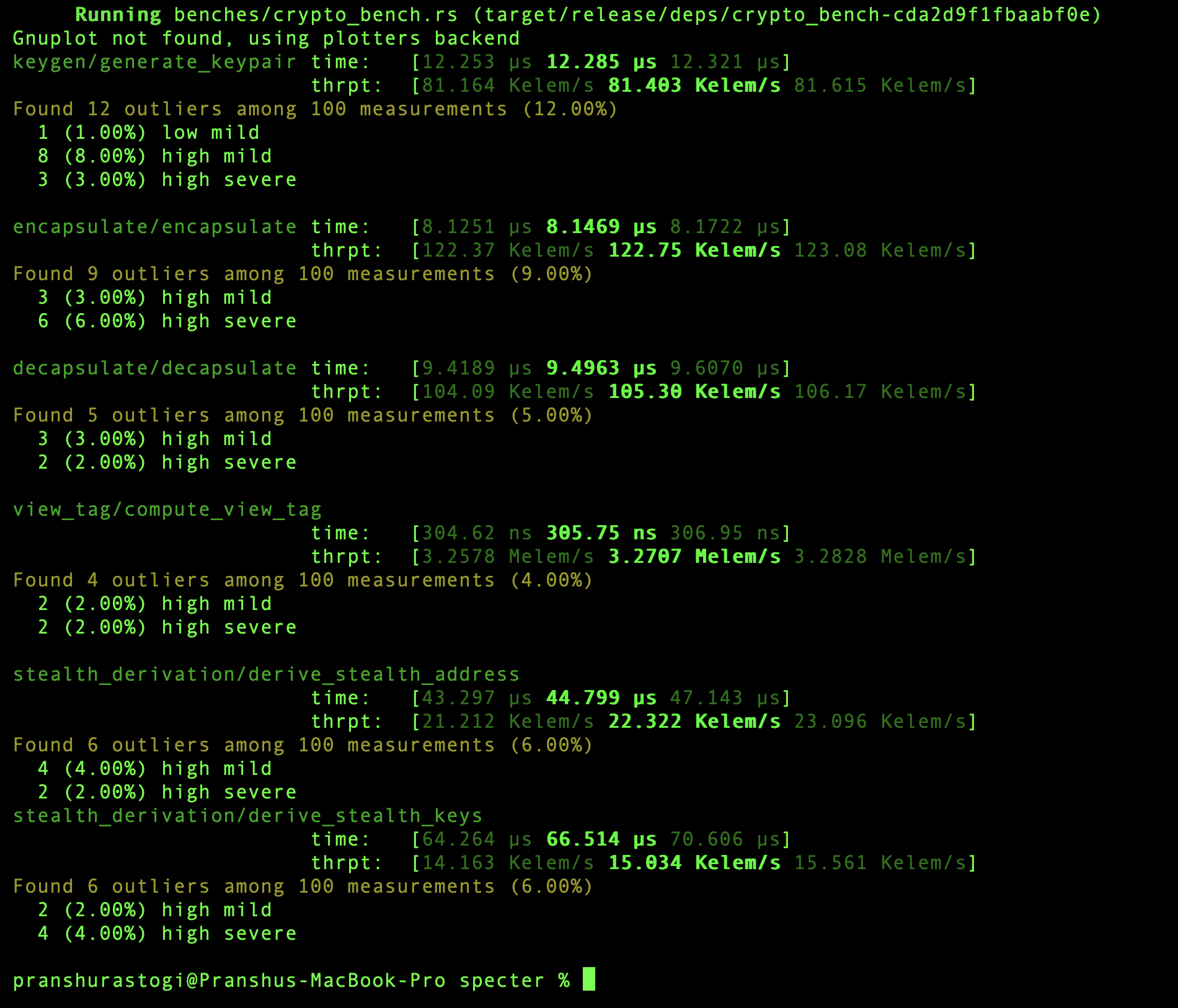
How scanning works in the API
stealth_address- the Ethereum address holding fundsstealth_sui_address- the Sui address equivalenteth_private_key- the derived spending keyview_tag- the matched tag- Metadata:
tx_hash,amount,chain,channel_id
View tags are not encryption
A view tag doesn’t hide anything. It’s an optimization, not a security feature. Anyone can see the view tag in the announcement. But knowing the view tag without the viewing secret key tells you nothing about who the recipient is.Protocol flow
See where scanning fits in the full payment process.
Security boundaries
What SPECTER protects and what it doesn’t.